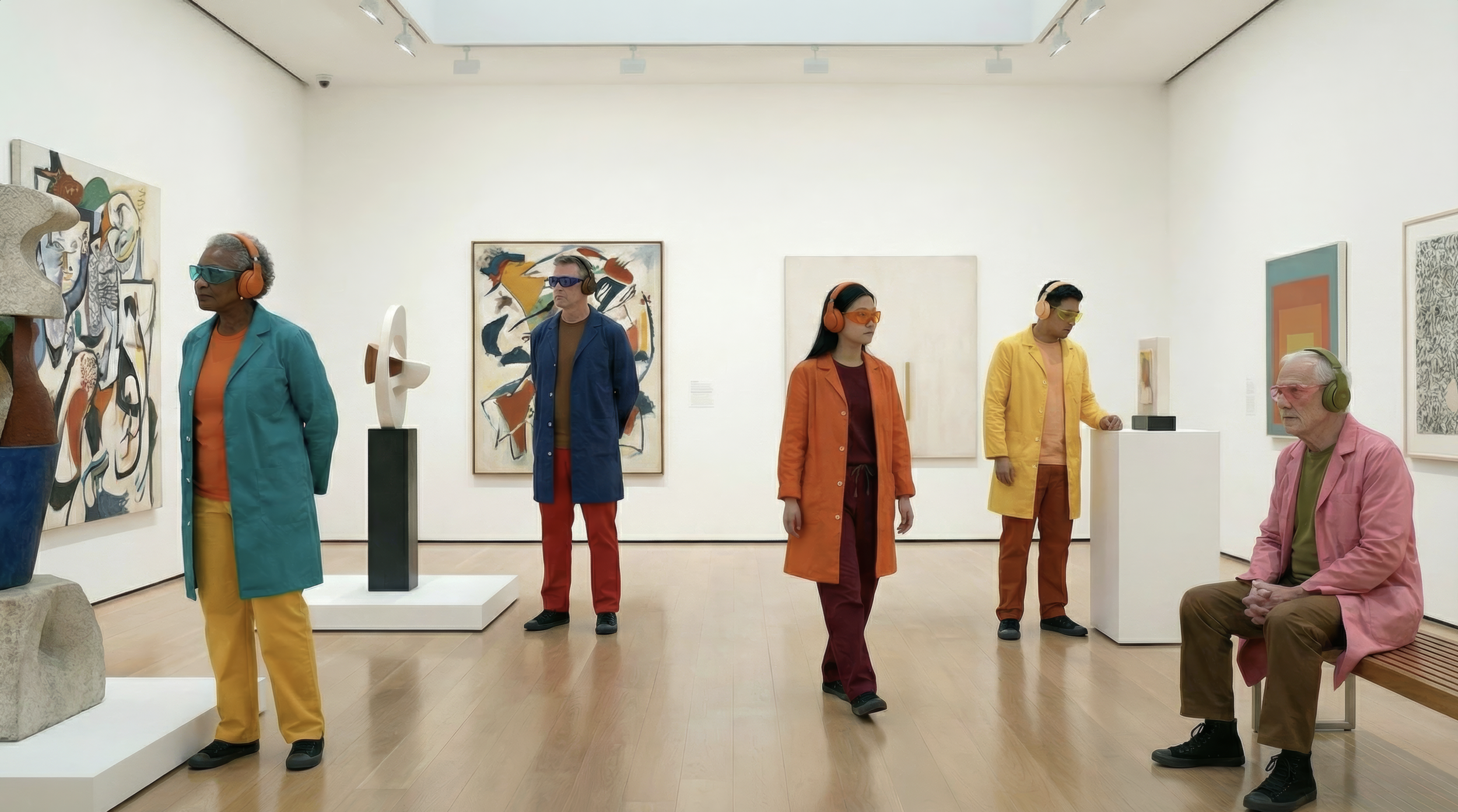
The Uniform
Every element of the Color Code research uniform serves multiple functions, and none of them are the functions for which the items were designed. The lab coat is not for a laboratory. The scrub pants are not for surgery. The safety glasses are not for protection. The headphones are not for listening to music. Each item has been repurposed into a component of something else: a color field, a social barrier, a recording device, a signifier of the technician class. The headphones seal the participant’s ears, signaling to other visitors that this person is occupied and unavailable for interaction. The tinted safety glasses heighten color perception and obscure the eyes, which is where strangers look to initiate contact. Together, they function as armor—not against physical danger but against the social fabric of the institution. The participant is insulated from casual interaction without doing anything conspicuous. They are simply someone who does not want to be bothered, which is entirely ordinary behavior in a gallery.
The uniform also performs a quieter function that intensifies as the project moves globally across geographies: it makes visible the question of who belongs in an art institution and on what terms. A museum is never a neutral container. It is an architecture of permission—of who is welcomed, who is watched, who is expected to look and how. When participants in Color Code enter an institution dressed in coordinated color and clinical accessories, they are legible as purposeful without being legible as any particular purpose. They could be staff. They could be researchers. They could be performers. This ambiguity is productive everywhere, but it registers differently depending on where the institution is and who the participant is. In some cities, a particular person in a lab coat moving slowly through a gallery is unremarkable. In others, it is an event. The uniform does not stage these tensions deliberately—it does not need to. It simply places bodies in institutions and lets the institution’s own social architecture do the rest. The work does not perform institutional critique. It conducts it, the way one conducts an experiment: by holding the method constant and changing the conditions.
The participants are not depicting Josef Albers' paintings. They are paintings of their own. A human body wrapped in a purple lab coat and red scrub pants, standing in front of a white museum wall, is a color relationship—as real, as optically active, as subject to the laws of simultaneous contrast as any arrangement of pigment on canvas. When that body moves to stand beside a Rothko, the relationship changes. When it stands near another participant dressed in teal and orange, it changes again. When it passes a window and the light shifts from artificial to natural, every color on the body transforms. The participants are walking exercises from Interaction of Color except the color chips have been scaled up to human bodies and placed in institutional space—and unlike Albers' paper swatches, these color fields carry biographies, fatigue, anxiety, curiosity, and the particular way each person holds their weight in a room, including the accumulated weight of everything they have seen before.