Color Code
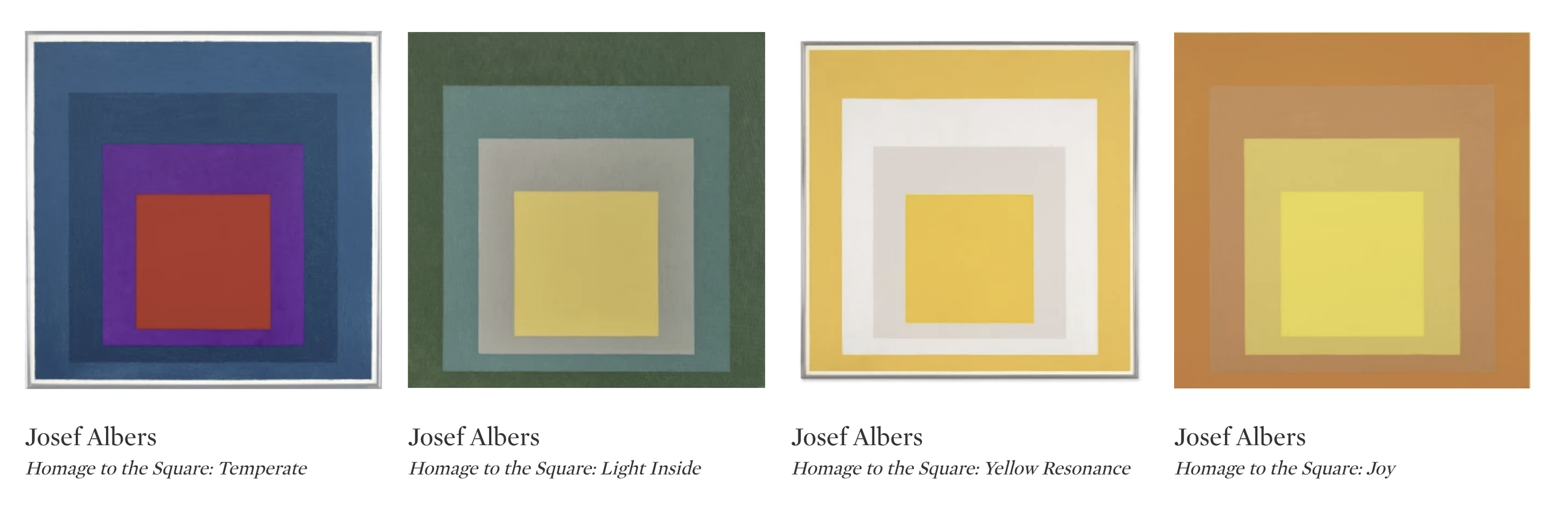
In 1950, Josef Albers began painting nested squares. He would continue for twenty-six years, producing hundreds of variations within a single formal constraint: squares of color, centered on a vertical axis, shifting in hue, value, and saturation. The paintings are not expressive. They are systematic. Each one is the output of a set of rules applied to a set of variables. Albers was not illustrating emotions. He was running experiments. But something unexpected happened to those who spent time with the work: the rigor produced a feeling. Viewers experienced a quiet destabilization, as if the paintings were looking back. His life's work demonstrated a single proposition with inexhaustible patience: that color has no stable identity. The same hue appears different depending on what surrounds it. Context determines perception. What we see is never simply what is there.
Albers was not alone in building art from systems rather than from self-expression. The twentieth-century avant-garde repeatedly discovered that the most radical creative acts often involved systems that worked to displace the author's conscious control. André Breton and the Surrealist poets practiced automatic writing, generating text by suppressing deliberate intention and allowing language to emerge from processes beneath or beyond the rational mind. John Cage used chance operations—coin tosses, star charts, the I Ching—to make compositional decisions no human ego had willed. Andy Warhol built a Factory that systematized appropriation, treating existing images as raw material to be processed through mechanical reproduction. In each case, the artist did not disappear. The artist designed the system, set its parameters, and decided what to do with its outputs. But the generative act itself was delegated to something other than conscious intention. And in each case, the system produced something the artist alone could not have made—not despite the delegation but because of it.
Artificial intelligence represents the latest and most powerful method of this delegation. The artist who engages AI not as a tool of efficiency but as an unpredictable participant in the work's construction is building on a foundation set by Cage, Warhol, and Breton. Color Code takes this lineage seriously. It does not treat AI as a novelty or a threat. It situates AI within the history of art's long experiment with the removal, distribution, and complication of authorial control, and it asks what happens when that experiment is conducted not only on a page or a screen but in physical space, on the body, and with raw material—where the work must be touched, built, and inhabited rather than merely viewed.
Color Code begins with people looking at art—carefully, slowly—and ends with constructed paintings built by hand from wood. But between the looking and the building, perception passes through a complicated chain of custody. Each finished painting is a physical record of personal human perception, machine interpretation, and material construction. At every stage, something is lost in translation and something is gained. What arrives at the end carries the accumulated weight of every mediation before it, and the warmth of every hand and eye involved in a work of distributed and communal authorship.