Research Expeditions
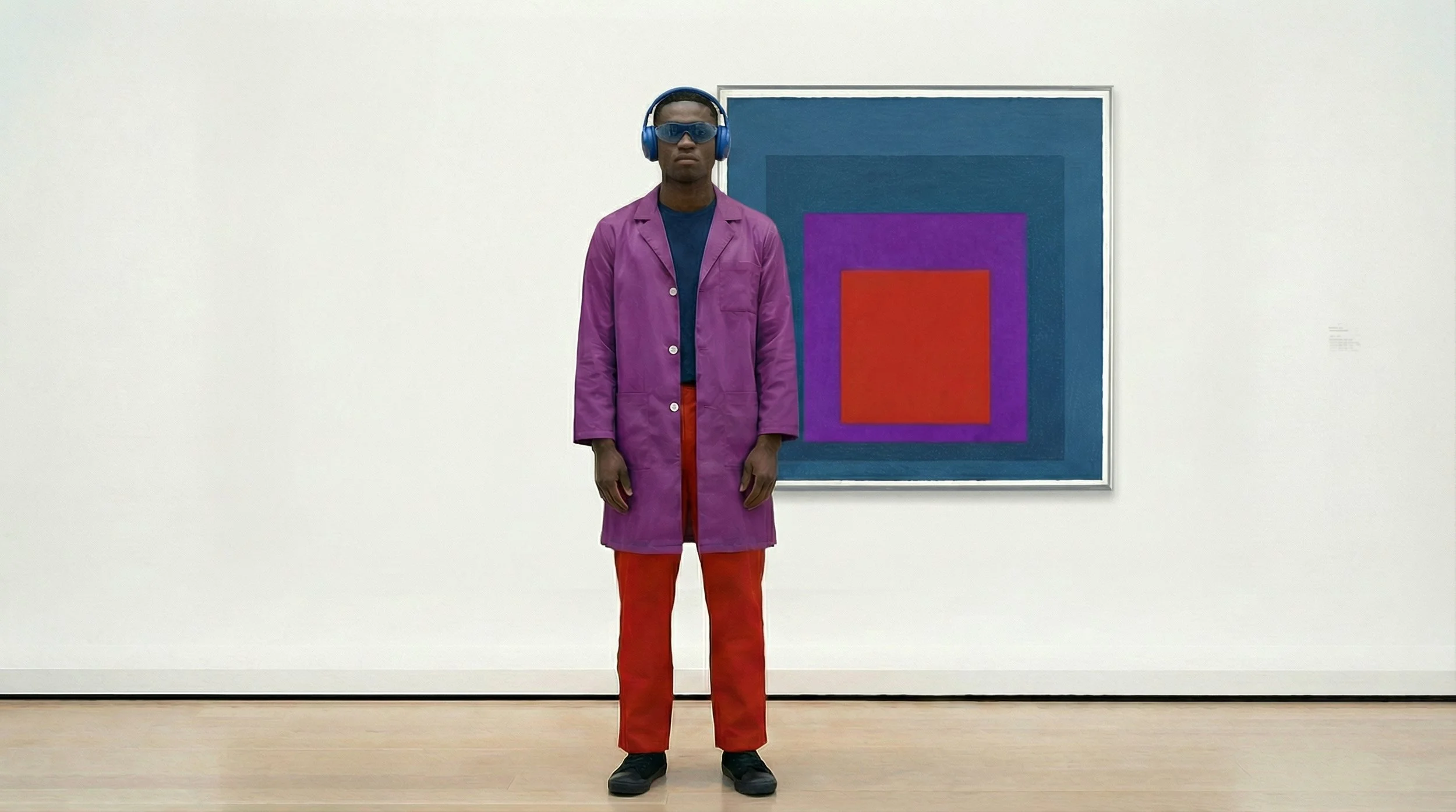
In each edition of Color Code, two to five participants enter an art institution—a museum, a gallery, an art fair—dressed in lab coats, scrub pants, safety glasses, and headphones, each uniform inspired by a specific painting from Josef Albers' Homage to the Square series. They move through the space the way any visitor might. They stand before paintings. They sit on benches. They look. The research expedition is, at its core, a structured meditation on color—sustained, attentive looking conducted under specific constraints. Through their headphones, at low volume, they listen to statements distilled from centuries of writing on color and perception—Goethe, Chevreul, Albers, Wittgenstein, Kandinsky, but also the Heian court's layered color-naming traditions, Navajo directional cosmology, Yoruba color symbolism, Andean textile knowledge, Islamic sacred geometry—a compressed history of human attention to the problem of how we perceive what Albers called the most relative medium in art. The audio in the headphones does not instruct. It primes. It gives the participants a vocabulary and an orientation toward careful looking without dictating what they should observe.
Against this background, the participants make notes in a color notebook: how the colors in the work before them interact with the colors they are wearing, how a painting shifts when viewed beside a fellow participant in a different palette, how the room's light and architecture inflect every chromatic relationship. A gallery visitor encountering them might feel that something deliberate is unfolding in the room without being able to say what. That quiet disturbance—the sense of careful attention—is part of the work. The research expeditions are documented photographically. The photographs do not capture specific observations. They record the condition: this body, in this uniform, in this room, on this day. They document the apparatus of perception, not the perception itself—the participant as a color field in institutional space, which is the same formal situation that will eventually be translated into wood and pigment in the project's final output: constructed paintings built by hand from wood.
The project is designed to operate at global scale. Each edition takes place in a different city, a different institution, a different cultural context—and crucially, with participants drawn from the local community where that institution is situated. A research expedition at a museum in Lagos is conducted with participants from Lagos. An edition at a gallery in São Paulo is conducted with participants from São Paulo. The work does not travel with its own observers. It meets the ones who are already there. This is a structural commitment, not a curatorial convenience. The project’s central proposition—that context determines perception—demands that the context change radically from edition to edition. And context, in this work, is not only the architecture of the room and the color of the walls. It is the person standing in the room: what they have seen before, what colors surrounded them as children, what associations they carry into institutional space, what it means for them to stand in a museum at all. These are not demographic variables to be catalogued. They are perceptual conditions that shape the data the work depends on, and they cannot be simulated, approximated, or sourced from a distance.