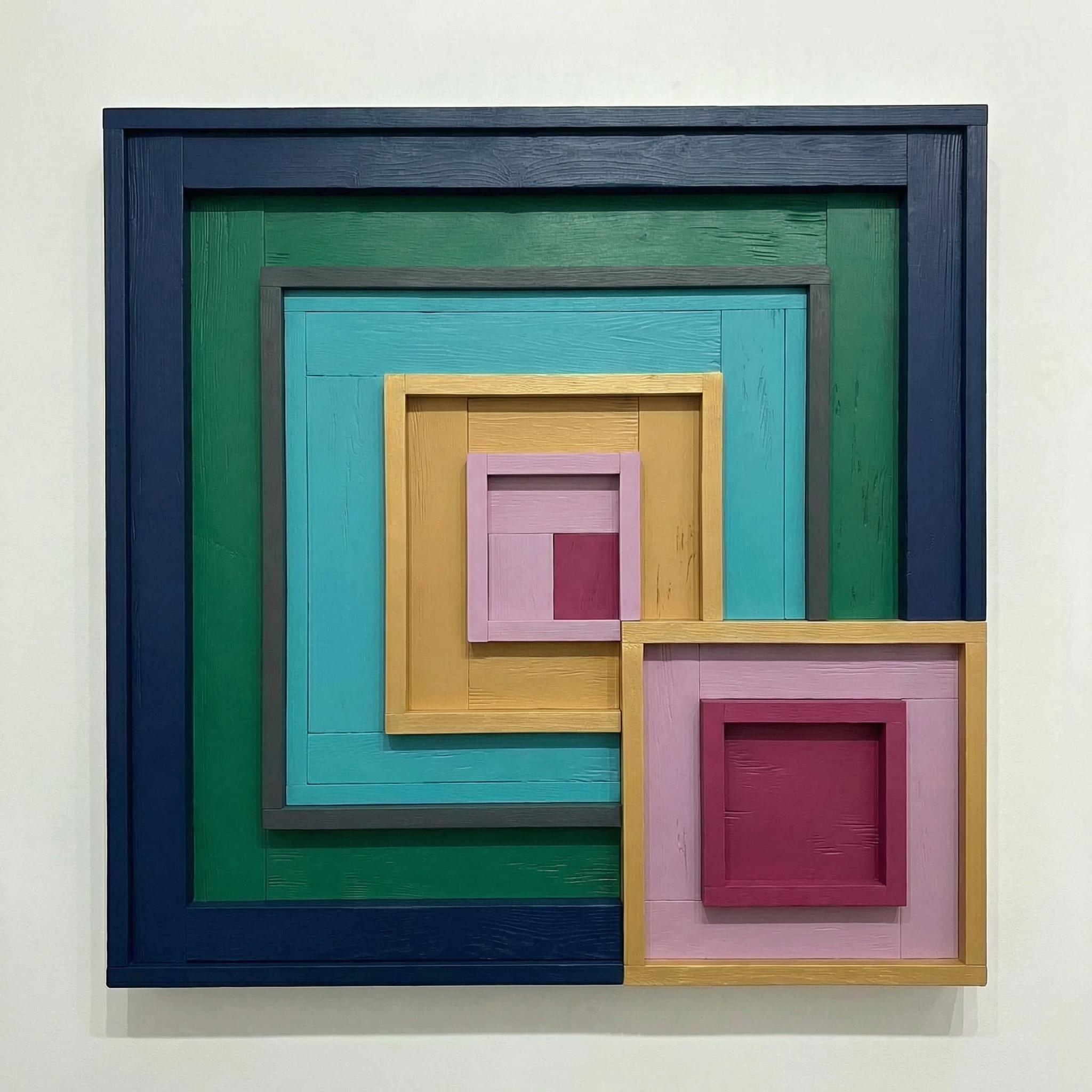
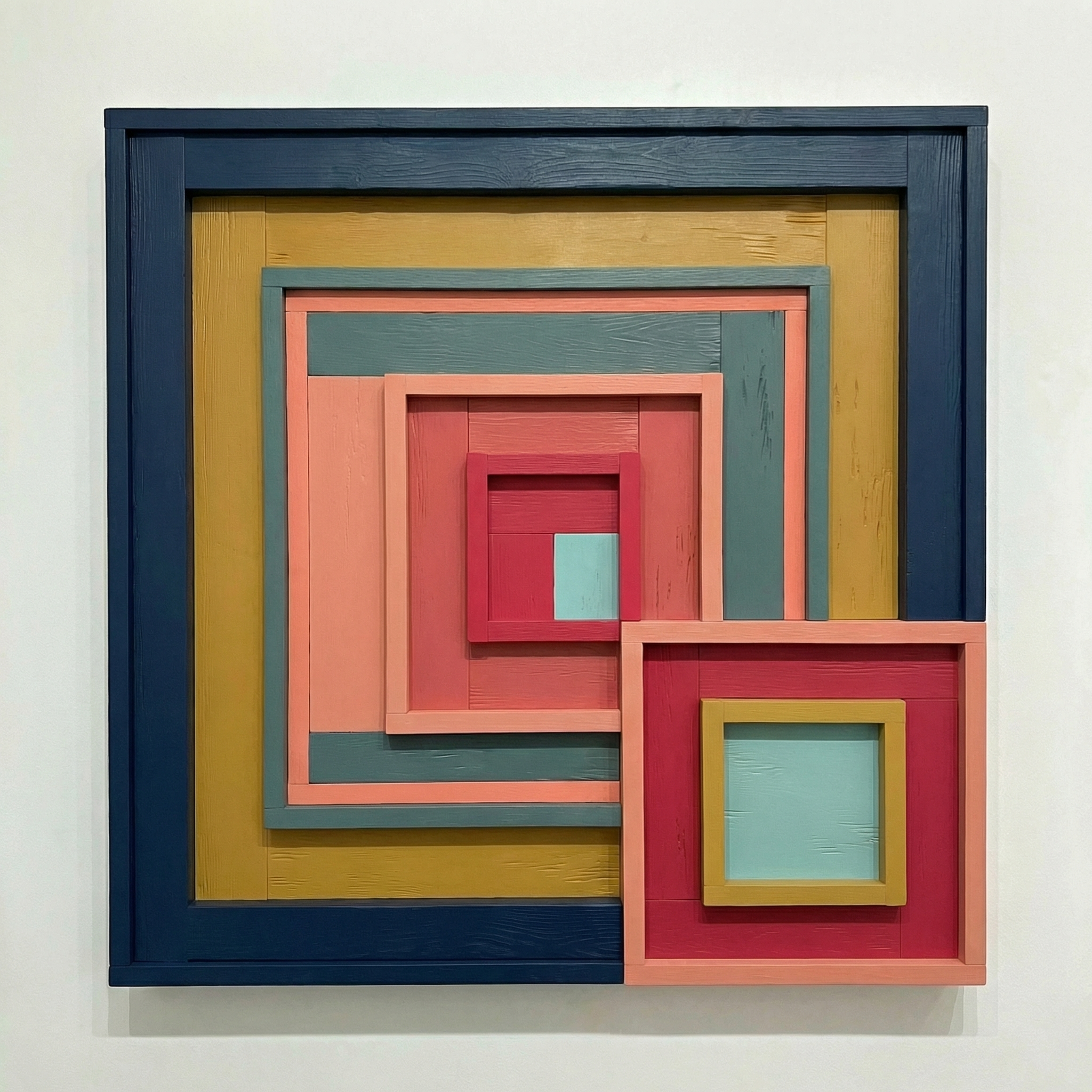
Constructed Paintings
The diary entries of the research participants do not remain as text. They pass through artificial intelligence, which translates the personal perceptual observations into a particular chromatic index—hues, values, and relationships derived from what the participants actually saw through their tinted lenses in a particular room on a particular day. These colors are overlaid onto a new structural proposal inspired by Homage to the Square: an arrangement of nested squares that respond to Josef Albers’ formal logic without replicating it. These two streams of data—personal color perceptions from the participant’s report and a purely structural reading of Albers—converge in the studio, where the artist builds each work by hand from standard lumber and plywood, cut, painted, and assembled into constructed paintings.
The constructed paintings are painted wood reliefs. Each one is built from roughly fifty pieces of standard lumber, cut to length, painted, and assembled in layers that project from the wall. The format is consistent across the series: a primary system of nested squares, offset from center, and a smaller satellite system of nested squares that overlaps the primary in the lower portion of the composition. The two systems coexist in the same frame without resolving into one. The primary set draws the eye inward, toward the center, in the manner of Albers’ paintings. The satellite interrupts that pull, creating a second focal point, a competing center of gravity. The eye oscillates between them and cannot settle. This formal irresolution is the visual equivalent of the project’s central concern: two systems—human and machine, original and interpretation, Albers and this new work—occupying the same space without collapsing into a single reading.
Each constructed painting is titled with the coordinates of its origin: the institution, the city, the date, and the participant whose perceptual report generated its colors. Color Code: Museo Tamayo, Mexico City, March 2026, [Participant Name]. Color Code: Tate Modern, London, October 2026, [Participant Name]. The title is not a caption. It is the painting's provenance, compressed into a single line—the minimum information necessary to reconstruct the chain of events that produced the object. The painting itself is opaque. Its colors have been abstracted from the perceptual conditions that generated them, absorbed into form the way any painting absorbs its origins. A viewer looking at the surface sees layered squares of color on wood. But the title insists that these particular colors are not arbitrary, not chosen by the artist's taste, not generated from nothing. They came from somewhere. Someone stood in a room, looked through tinted lenses at a work of art, and described what they saw. The title names that someone and that somewhere, and in doing so it keeps the constructed painting tethered to the body, the institution, and the moment that produced it—even as the painting, in its silence, offers no confirmation of any of this.